Not all pigmentation is the same.
Learn how to target age spots effectively
— without bleaching or irritation.
Age spots — or solar lentigines — are one of the most common pigmentation concerns we treat at ESSEL. These flat, brown or dark patches often develop after years of sun
exposure, especially on the face, chest, shoulders, and hands. While more common in individuals over 50, age spots can appear earlier in those with frequent sun exposure — especially skin types I to III. What makes them particularly stubborn? They aren’t just caused by melanin buildup… they also contain lipofuscin, a pigment from oxidised proteins and fats that accumulates in the cells as we age. Age spots — or solar lentigines — are one of the most common pigmentation concerns we treat at ESSEL. These flat, brown or dark patches often develop after years of sun exposure, especially on the face, chest, shoulders, and hands.
While more common in individuals over 50, age spots can appear earlier in those with frequent sun exposure — especially skin types I to III. What makes them particularly stubborn? They aren’t just caused by melanin buildup… they also contain lipofuscin, a pigment from oxidised proteins and fats that accumulates in the cells as we age.Age spots — or solar lentigines — are one of the most common pigmentation concerns we treat at ESSEL. These flat, brown or dark patches often develop after years of sun exposure, especially on the face, chest, shoulders, and hands. While more common in individuals over 50, age spots can appear earlier in those with frequent sun exposure — especially skin types I to III. What makes them particularly stubborn? They aren’t just caused by melanin buildup… they also contain lipofuscin, a pigment from oxidised proteins and fats that accumulates in the cells as we age.
Why Age Spots Are So Tough to Treat
Most pigmentation products and treatments only target melanin. But lipofuscin, a key component of age spots, is often overlooked — and it’s harder to remove because it’s essentially cellular waste build-up. That’s why DNA EPINEW Skin Tone Corrector is a standout treatment. It includes ferulic acid, a powerful antioxidant that fights oxidative stress and enhances other ingredients for more effective pigment control.
Why Bleaching Ingredients Aren’t Always Safe
Bleaching agents like hydroquinone are commonly used to treat age spots — but they aren’t suitable for all skin types, especially in sun-rich climates like South Africa. These ingredients can trigger adverse reactions when exposed to sunlight. Instead, we recommend safer, non-bleaching alternatives that regulate tyrosinase (the enzyme that produces melanin) and even out pigment distribution.
Recommended ESSEL Products for Age Spots
CONTROL with Safe, Potent Ingredients
RESURFACE with Retinol — the Right Way
Retinol is a gold standard for treating pigmentation, but not all retinoids are created equal.
Some forms are too harsh, while others are barely effective.
Aesthet Retinol Cream
o Uses pure retinol (the strongest non-prescription form)
o Features slow-release technology for maximum results with minimal
irritation
o Safe for all skin types – no “retinizing” effect
Retinol also boosts cell turnover, smooths skin texture, and enhances brightness —
making it a powerhouse for pigmentation and aging.
PREVENT with Daily Sun Protection
Sun exposure is the #1 trigger for age spots — so preventing further damage is non-
negotiable.
DNA EPINEW SPF 30 Cream
o Lightweight, moisturising protection
o Ideal for daily use
DNA EPINEW SPF 50 Spray
o Non-greasy and ultra-convenient
o Great for makeup users and on-the-go reapplication
In-Practice Treatments to Support Your Routine
Professional treatments can significantly enhance results when combined with the right
products.
Recommended:
Aesthet Expert Chemical Peel
o Gentle enough for all skin types
o Specifically formulated to target pigmentation
MesoSkin Therapy
o Boosts product absorption and skin rejuvenation
o Can be combined with pigmentation serums for even tone

the impact of consistent product + in-practice treatments.

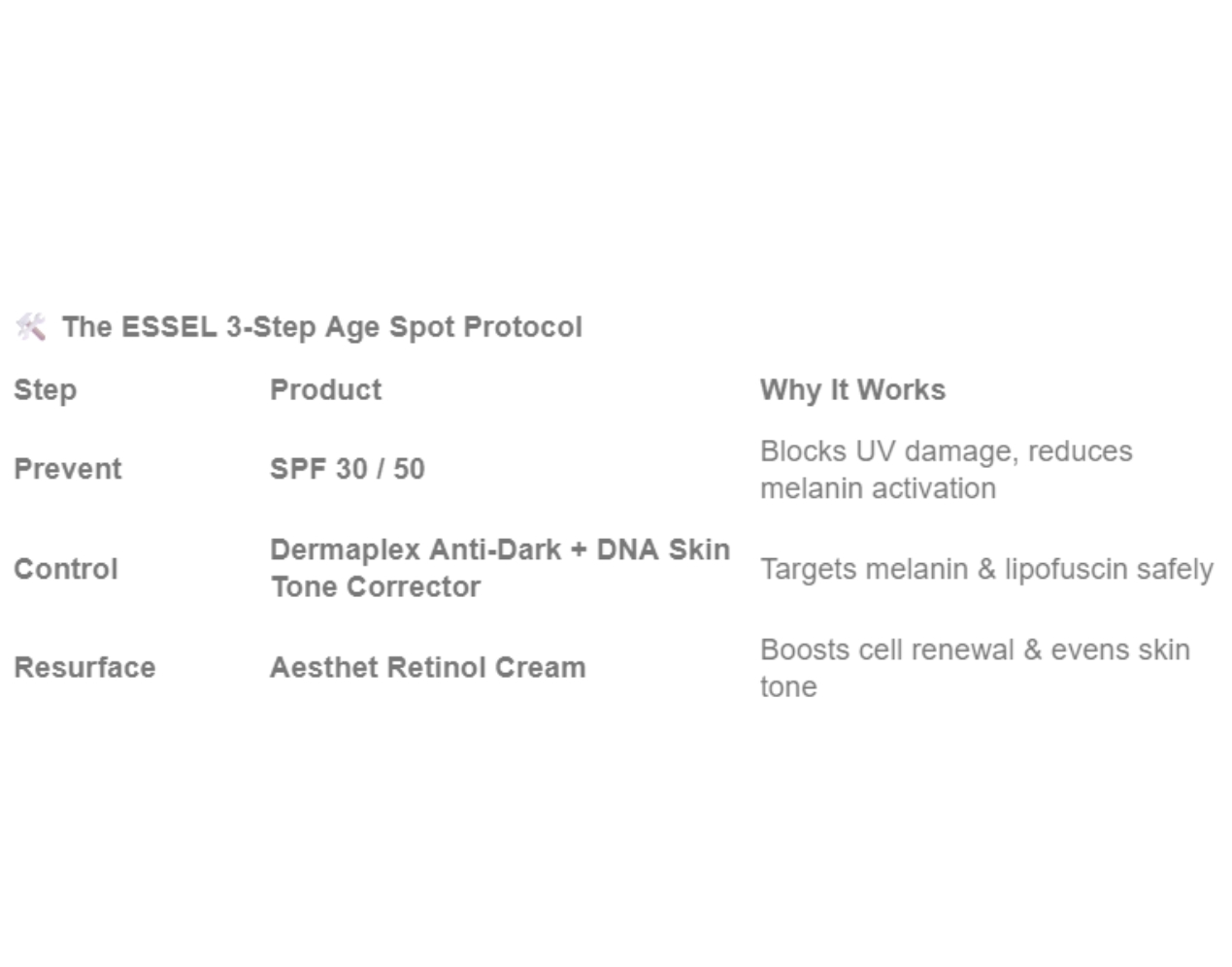
The full 3-step protocol
“Retinol also boosts cell turnover, smooths skin texture, and enhances brightness —
making it a powerhouse for pigmentation and aging.”
some related posts
Transforming Skin, Elevating Confidence